

.avif)

.avif)
.avif)
From the simplest lens, Solo DnD with AI swaps your human dungeon master for software that builds the story on the spot. In contrast, traditional DnD keeps a real person in that chair, running the game from memory and gut instinct.
Same fantasy itch, wildly different way of scratching it.
I've been the friend everyone begs to run a campaign, and I've also opened an app on a random Tuesday because getting 4 adults in the same room felt like herding cats. Both are real ways to play. Neither is the "correct" one.
Some folks discover this whole genre by scrolling through interactive story games first and stumbling into something built specifically around Dungeons & Dragons-style adventuring.
Wit's End goes at it from a different angle entirely, putting a live game master on your TV who narrates out loud while your whole group shouts back at the screen.
Both formats can hand you a genuinely great night. They just get there on completely different roads.
{{cta-witsend}}
Solo DnD with AI vs. traditional DnD quick answer
The key difference boils down to who's in the chair.
Software gets you playing in minutes with nobody to wrangle, while a real dungeon master brings judgment and memory a script still can't fully fake.
Everything below, from setup speed to how deep the rules go, traces back to this one split, and it's the reason the pile of AI RPG games keeps growing.
What is solo DnD with AI? (A deeper look)
Solo DnD with AI is any Dungeons & Dragons-style adventure where software takes over the world-building and reacts to your choices instead of a person doing it. Yet, not every tool in this space handles that job the same way.
Some lean hard into replicating the tabletop rulebook down to the character sheet, tracking spell slots and hit points the way a 5e app would. Others go looser, playing more like the freewheeling fantasy worlds in games like Fable than a strict simulation of combat math.
Wit's End sits firmly in that second camp. You talk through your character out loud on your TV, and a live game master builds a quest around whatever you say, with nothing for you to write down and dice rolls deciding your fate.
Looser storytelling like this is riding the same wave as the broader boom in AI storytelling formats, where the fun comes from reacting in the moment rather than optimizing a build.
The catch nobody advertises up front is memory.
Ask anyone who's tried a handful of these tools, and you'll hear the same complaint. It's shockingly easy for software to lose the thread on small stuff, like which hand your character lost in that fire giant fight, a few exchanges after you mentioned it.
It's the real tradeoff worth knowing before you commit a Saturday night to it.
What is traditional DnD? (A deeper look)
Traditional DnD is the original tabletop game, where a human dungeon master builds and runs the story while everyone else plays a character, and that job goes deeper than most people realize before they sit in the chair.
The DM tracks the terrain, what every NPC wants, and how every choice the party made 3 sessions ago is about to bite them, often all in the same breath.
When a player tries something risky, like sweet-talking a guard or leaping across a collapsing bridge, the DM sets a target number called a Difficulty Class.
The player rolls a 20-sided die, called a d20, adds their character's bonuses, and if the total clears that number, it works. Roll a natural 20, meaning the die itself lands on 20 before any bonuses, and an attack hits no matter what, which is exactly the kind of moment that makes a table erupt.
You can absolutely play traditional DnD by yourself too, pulling from a random table or oracle deck to answer questions the way a DM normally would, then interpreting whatever comes up.
It's slower to get going than opening an app, but every dragon's lair looks exactly the way you pictured it, because you're the one building it.
If you've never touched the hobby before, most guides built around DnD for beginners will tell you to start small with a short published adventure instead of building a world from a blank page on day one.
Solo DnD with AI vs. traditional DnD key differences
Key differences include memory, continuity, setup time, depth of rules, allowed improvisation, replayability, storytelling mechanics and quality, and the emotional and social payoff.
1. Memory and continuity
A human DM remembers that your rogue swore off using swords 2 arcs ago out of pure spite. Software running that same story doesn't always hold onto that kind of detail.
A common pitfall of using an AI tool is that it can quietly flip a character's race or class mid-adventure based on a single throwaway line, which means players end up keeping their own notes as a safety net.
A person running the game just remembers, because they were there. Software needs to be fed the context again to stay accurate deep into a long story.
2. Setup time
Traditional DnD needs real coordination. Someone has to write a campaign, dig up rulebooks, and get an entire group's calendars to line up on the same night, which is basically a small miracle in adult life.
Solo software erases most of that. Open Wit's End on Fire TV, LG, or Samsung Smart TV, describe your character out loud, and you're already inside a story within minutes.
Speed like that is exactly why so many people go looking for AI Dungeons & Dragons options in the first place. It turns "let's play D&D" into something you actually do tonight, not something you plan 2 weeks out.
3. Rules depth vs. improvisation
Some tools built directly on 5e-style systems try to replicate tactical combat and full character builds with real mechanical weight. It's the pick if you want tabletop crunch without needing a person to referee it.
Wit's End trades that precision for pure improvisation. It keeps the story fast and reactive without leaning on strict mechanics, closer to games that feel like D&D in spirit than a full simulation of its rulebook.
Traditional DnD sits at the rules-heavy end by default, since a trained DM can apply the Player's Handbook with the kind of nuance that scripted systems still don't fully match, especially in the bizarre edge cases no rulebook ever saw coming.
4. Replayability and story variety
A traditional campaign usually runs once through a given adventure, since the DM and any returning players already know how the plot shakes out.
Wit's End sidesteps that limit completely. It builds a new quest every session, so replaying doesn't mean living through the same plot twice, and your group can jump back in next weekend without retracing old ground.
5. Emotional and social payoff
A human DM can read the room. They notice when a joke lands, when a player wants a quiet character moment instead of another fight, and when it's time to crank up the tension, then adjust the scene live in ways software still can't fully match.
Software flips that tradeoff around. Nobody has to prep the session or carry the emotional weight of the table alone, which frees even the person who'd normally be stuck running it to just react to the story with everyone else.
When to use solo DnD with AI vs. traditional DnD
Use solo DnD with AI when …
- You want to play tonight, no scheduling required
- You're D&D-curious and want a low-pressure way to try the basic loop before committing to a full table
- You want a shared session for the whole room, in the same spirit as the games with siblings people pull out on a random weeknight
Use traditional DnD when …
- You have a group who can meet regularly and want one long story that everyone remembers
- You care about tactical combat, and character builds run by someone who knows the full rule set inside and out
- You want full creative control over tone, pacing, and difficulty instead of handing those calls to software
A new way to enjoy a fantasy campaign
Solo DnD with AI wins on pure convenience, while traditional DnD still wins on depth for a group chasing one long story that sticks. Plenty of people end up doing both, depending on what kind of night it is.
If Wit's End has you curious about what else lives on the same platform, the answer is a whole game night's worth of options. With the Weekend app installed, your living room turns into the place where everyone wants to play, and fantasy adventuring is just one of the rooms in that house.
Games you can pull up on Weekend, once the app is running on your TV:
- Jeopardy! gives trivia fans a fresh challenge after the playlist ends. Choose Casual, Classic, or Expert, then shout your answer when the clue appears.
- Song Quiz brings music trivia across decades and genres to the room. Hear a short clip, then shout the song and artist to earn points.
- Wheel of Fortune pairs partners as puzzle solvers. Spin the wheel, call letters, and solve the board.
- Spot On sends the room around the world from the couch. Drop a pin and see who gets closest.
- Guess the Emoji gives visual-puzzle fans fast clues to decode. A row of tiny pictures can cause a surprisingly big argument.
- Karaoke (on Roku) puts singers in the spotlight. The game tracks lyrics and pitch, so each chorus gives you a score to chase.
- Sketchy AF builds a drawing a stroke at a time, and the earlier you guess, the more you score.
- 20 Questions (on Roku) rewards the group that asks sharper questions. Keep narrowing the possibilities until someone calls it.
- Meme Supreme lets everyone vote on the funniest response to each strange prompt. Bring your best internet brain.
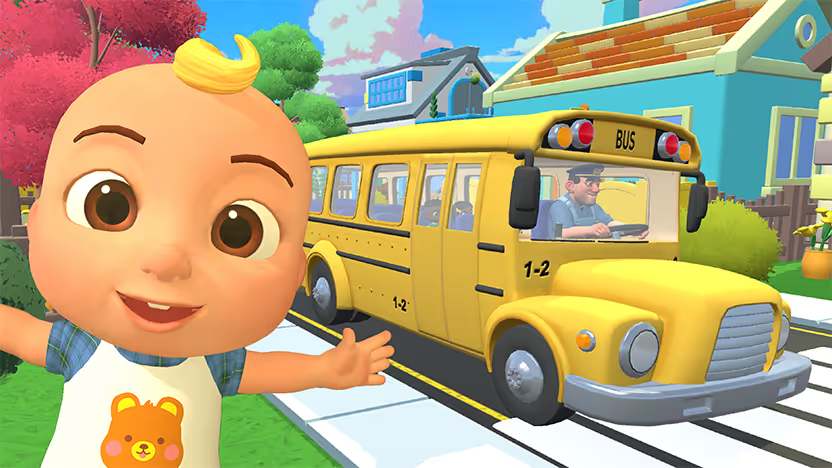
- CoComelon: Sing & Play with JJ brings toddlers aged 2 to 4 familiar songs and educational activities.
Start the 7-day free trial, pick a game, and find out which one your group ends up asking for every single week.
FAQs
Can you really play D&D-style games completely solo with AI?
Yes, playing D&D-style games completely solo with AI is genuinely possible and more common than you'd think. A handful of tools let one person build a character and play through a generated adventure alone, and I'd count Wit's End among the tools bringing that same idea to a shared TV screen.
Is solo DnD with AI a good way to learn D&D basics?
Yes, solo DnD with AI is a solid way to learn D&D basics without the pressure of a full table. In my experience, it teaches the loop of describing actions and seeing what happens next, though it won't cover the tactical depth of full 5e rules the way a human-run table eventually will.
Do AI-run tools remember my character between sessions?
Not always, and that inconsistency is the most common complaint about AI-run tools. Some track quest progress and character details automatically, while others lose that thread the longer a session runs, so I'd suggest keeping personal notes as backup either way.
Is Wit's End available on Roku?
No, Wit's End isn't available on Roku right now. It currently lives on Fire TV, LG, and Samsung Smart TV, while other Weekend Games like Jeopardy!, Song Quiz, and Wheel of Fortune are available across all 4 platforms.
How can I get Weekend Games on my smart TV?
You can get Weekend Games on your smart TV by searching "Weekend" in the app store on Fire TV, LG, or Samsung Smart TV. Launch the app and start a 7-day free trial to play Wit's End, Jeopardy!, Wheel of Fortune, and more.









.png)
.png)
.png)

Free for 7 days. Cancel anytime.


